Blog

  • Zakat Al Fitr Rulings Explained Fatwa_650.png

    The Rulings of Zakat al-Fitr | Fatwa (Ibn Baz & Uthaymeen)

    What is the ruling of Sadaqah al-Fitr?

    Shaikh Bin Baaz said:
    Zakat al-Fitr is obligatory on every Muslim, old and young, male and female, whether he is free or if he is a slave.

    Al Fataawa (14/ 197)


    From what is Zakat al-Fitr to be given in?

    Shaikh Bin Baaz said:
    It is to be given out as a measurement of food. That is a saa’a of dates or a saa’a of barley or a saa’a of raisins. Any of these types of food products is permissible. The scholars have also said, everything that the people of your particular land consider as their daily food such as rice or wheat or any grains etc.. is also permissible to be given as Zakat al-Fitr.

    NOTE: A Saa’a is approximately 3 kilograms.


    When is the Zakat al-Fitr to be given out?

    Shaikh Bin Baaz said:
    It is to be given out on the 28th day or the 29th day or the 30th. Even the night before the Eid Prayer, or the morning of the Eid but before the prayer.

    Al Fataawa (14/32-33)


    What is the reason behind giving out Zakat al-Fitr?

    Shaikh al-Uthaymeen said:
    To show your grateful for the blessings of Allah the Most-High on the Eid with breaking your fast from Ramadaan and it’s completion.

    Al Fataawa (18-257)


    And who is this Zakat al-Fitr to be given to?

    Shaikh al-Uthaymeen said:
    It is not to be given out to anyone except the poor.

    Al Fataawa (18/259)


    What is the ruling on entrusting one’s children or other than them to pay his Zakat al-Fitr?
    Shaikh al-Uthaymeen said:

    It is permissible to entrust one’s children to pay his Zakat al-Fitr for him when it is time. Even if at that time they send it from another country.

    Al Fataawa (18/262)


    Is it permissible for the one that is poor to entrust someone else to collect his Zakat al-Fitr?

    Shaikh al-Uthaymeen said:
    That is permissible.

    Al Fataawa (18/268)


    Is there any specific dua or statement that one must say when he gives out his Zakat al-Fitr?

    We are not aware of any specific dua that one must say when he is distributing his Zakat al-Fitr.

    The Permanent Committee of Scholars (9/3877)


    Is it permissible to give out the value of the weight of the food stock as your Zakat al-Fitr?

    Shaikh al-Uthaymeen said:
    Giving the Zakat al-Fitr out as money is not permissible. Verily it has been specified as food.

    Al Fataawa (18/265)


    Is it necessary that the Zakat al-Fitr meets a certain quorum before you have to give it out?

    Shaikh Bin Baz said:
    The Zakat al-Fitr does not have to meet any quorum, but it is mandatory on the Muslim to give it out on himself and everyone in his household, from his children and his wife and his slaves. If he has enough food for himself and all of them for a day and a night.

    Al Fataawa (14/ 197)


    What is the specific amount for Zakat al-Fitr?

    Shaikh Bin Baz said:
    That which is incumbent is a single saa’a from the food of that country. And that amount in kilograms is approximately 3 kilograms.

    Al Fataawa (14/ 203)


    Is it permissible for the one paying his Zakat al-Fitr to give out in other than the land he resides?
    Shaikh Bin Baz said:

    It is the Sunnah to dispence it amongst the needy in his own country. Because not sending out to other lands will help enrich the needy in his own country and ease their needs.

    Al Fataawa (14/ 213)

    Does one have to pay Zakat al-Fitr on the servants in his house?

    Shaikh al-Uthaymeen said:
    These servants in his house, Zakat al-Fitr is mandatory upon them if they are from the Muslims.
    But the basis of this Zakat is that it is upon the servants. But if he pays for them when he pays for his family there is nothing wrong with this.


    Does one have to pay Zakat al-Fitr on the unborn child in the stomach of its mother?

    Shaikh al-Uthaymeen said:
    One does not have to pay Zakat al-Fitr on the child carried in it’s mother’s stomach because it is not present. But you can if you prefer.

    Al Fataawa (18/263)


    Is it permissible to give Zakat al-Fitr to workers that are not Muslims?

    Shaikh al-Uthaymeen said:
    No it is not permissible to give to anyone other than the needy from the Muslims.

    Al Fataawa (18-285)


    Is the Zakat al-Fitr of one person only to be given out to one other person or can it be given to a number of different people?

    It is permissible to give one’s Zakat al-Fitr to one person just as it is permissible to dispense it amongst a number of different people.

    The Permanent Committee of Scholars (9/3777)


    What is the ruling on after one receives Zakat al-Fitr he sells it?

    If it was his right to receive it, then it is permissible for him to sell it after he received it.

    The Permanent Committee of Scholars (9/3800)


    What is the ruling on the one that delayed giving out his Zakat al-Fitr till after the Eid prayer without any justified excuse?

    Shaikh al-Uthaymeen said:
    Delaying it until after the prayer is sinful and it is not accepted from him.

    Al Fataawa (18-266).


    When to give the Zakat al Fitr?

    Sheikh Salih Al ‘Usaymi, may Allah preserve him, said:
    In the authentic (narrations), the Prophet ﷺ said: “Indeed, the month is twenty-nine days.” So advancing it by a day or two would be from the night of the twenty-eight.
    Thus, when the sun of the twenty-seventh sets, the time for the Zakat al Fitr begins. And if the month is completed (to thirty days), then the addition of that day is a grace (favour) from Allah in increasing the days of Ramadan and expanding the time for giving (the Zakat al Fitr).


  • Worried About Your Past_106.png

    Worried About Your Past? Return to Allah

    Worried About Your Past? Return to Allah ارجع إلى الله

    We all have moments we wish we could undo — mistakes, sins, or choices we regret. But in Islam, no past action is too heavy for the mercy of Allah. Whatever you’ve done, whether moments ago or years ago, you can always return to Him.

    Scholars’ Quotes

     
    Sheikh Al-Islam Ibn Taymiyyah رحمه الله said:
    "The account (of a person) is according to the perfection of the end, not according to the flaws of the beginning."
    — Fatawa (V.10, P.305)
     
    Ahmad Ibn Asim رحمه الله said:
    "Clean up the rest of your life and you will be forgiven for your past."
    — Az-Zuhd Al-Kabeer, P. 228

    Hadith
     
    The Messenger of Allah ﷺ said:
    "The one who repents from sin is like one who did not sin."
    — Ibn Majah (4250), classed as Hasan by Sheikh Al-Albani رحمه الله

    Qur’an Verses
     
    Surah Al-Furqan 25:70
    سورة الفرقان
     
     إِلَّا مَنْ تَابَ وَءَامَنَ وَعَمِلَ عَمَلًا صَالِحًا فَأُولَـٰئِكَ يُبَدِّلُ ٱللَّهُ سَيِّئَاتِهِمْ حَسَنَاتٍ وَكَانَ ٱللَّهُ غَفُورًا رَّحِيمًا


    "Except those who repent and believe (in Islâmic Monotheism), and do righteous deeds; for those, Allâh will change their sins into good deeds, and Allâh is Oft-Forgiving, Most Merciful."
     
    Surah Az-Zumar 39:53
    سورة الزمر
     
     قُلْ يَا عِبَادِيَ الَّذِينَ أَسْرَفُوا عَلَى أَنفُسِهِمْ لَا تَقْنَطُوا مِن رَّحْمَةِ اللَّهِ ۚ إِنَّ اللَّهَ يَغْفِرُ الذُّنُوبَ جَمِيعًا ۚ إِنَّهُ هُوَ الْغَفُورُ الرَّحِيمُ


    "Say, 'O My servants who have transgressed against themselves [by sinning], do not despair of the mercy of Allāh. Indeed, Allāh forgives all sins. Indeed, it is He who is the Forgiving, the Merciful.'"
     
    Surah At-Tahrim 66:8
    سورة التحريم
     
     يَا أَيُّهَا الَّذِينَ آمَنُوا تُوبُوا إِلَى اللَّهِ توبةً نصوحًا عَسَىٰ رَبُّكُمْ أَن يُكَفِّرَ عَنكُمْ سَيِّئَاتِكُمْ وَيُدْخِلَكُمْ جَنَّاتٍ تَجْرِي مِن تَحْتِهَا الْأَنْهَارُ ۖ


    "O you who believe! Turn to Allâh with sincere repentance! It may be that your Lord will expiate from you your sins, and admit you into Gardens under which rivers flow (Paradise) — the Day that Allâh will not disgrace the Prophet (Muhammad ﷺ) and those who believe with him. Their Light will run forward before them and (with their Records - Books of deeds) in their right hands. They will say: 'Our Lord! Keep perfect our Light for us [and do not put it off till we cross over the Sirât (a slippery bridge over the Hell) safely] and grant us forgiveness. Verily, You are Able to do all things.'"

    Closing Message
     
    Remember: every sincere step back to Allah is never wasted. Even if you sinned just seconds ago, take that step now — even if it’s your millionth attempt, start fresh. ارجع إلى الله — return to Allah — and trust in His mercy.
     
    — Your brother, Rabeeh Ameen
    Founder & CEO, Barakah Jobs

  • Let the days go forth poem excerpt barakah jobs (808 x 572 px)_473.png

    An Excerpt from Imam Al-Shafi‘i’s Poem “Let the Days Go Forth”

    In a world where life’s ups and downs often leave us anxious, Imam Al-Shafi‘i رحمه الله offers a timeless reminder in his poem دع الأيام تفعل ما تشاء (Let the Days Go Forth). This excerpt teaches us that true contentment and security lie in trusting Allah’s plan for our provision, or rizq.

    Your provision will not be decreased due to life’s delays,

    And it cannot be increased due to your haste.
    No sadness lasts forever, nor any happiness,
    And you shall not remain in poverty, or any luxury.
    If, in your heart, you possess contentment,
    Then you and those who possess the world are equal.

    وَرِزْقُكَ لَيْسَ يُنقِصُهُ التَأَنِّي
    وَلَيْسَ يَزِيدُ فِي الرِّزْقِ الْعَنَاءُ
    وَلَا حُزْنٌ يَدُومُ وَلَا سُرُورٌ
    وَلَا بُؤْسٌ عَلَيْكَ وَلَا رَخَاءُ
    إِذَا مَا كُنْتَ ذَا قَلْبٍ قَنُوعٍ
    فَأَنْتَ وَمَالِكُ الدُّنْيَا سَوَاءُ

  • 3 Ways to attain barakah (808 x 572 px)_20251020_200424_0000_175.png

    3 Ways to Attain Barakah: Timeless Advice from Sheikh Ruhayli

    In our pursuit of success — whether it’s in our career, family, or daily life — we often overlook the simple, powerful means that bring true barakah (divine blessing). Sheikh Ruhayli, in one of his insightful lectures, beautifully summarized three key actions that attract Allah’s grace and abundance. His words serve as a reminder that spiritual effort precedes worldly gain. 

    Sheikh Ruhayli says in this excerpt from a lecture:

     
    "Therefore, if you want something in this world. You must focus on three matters. Which, by the will of Allah, bring Allah's grace. The first is seeking forgiveness, increase in seeking forgiveness, if you want a job, if you want wealth, if you want a child, if you want depression to leave you, if you want worry to leave you, increase in seeking forgiveness. If you see that your wife is not suitable for you. She exhausts you, does not obey you, increase in seeking forgiveness. The second is supplication. Strive in supplication. The third is righteous deeds. For through righteous deeds, you receive Allah's blessings in this world and you are rewarded for them in the hereafter."

  • what is tawakkul & how do we understand it __20251006_220501_0000_431.png

    What is Tawakkul & How Do We Understand It? | Shaykh Ibn Uthaymeen رحمه الله

    Tawakkul (trust in Allah) is one of the most profound acts of the heart — balancing reliance on Allah with taking the means. Shaykh Ibn Uthaymeen رحمه الله beautifully explained how true tawakkul combines sincere faith with responsible effort. In this post, we explore what tawakkul truly means and how to apply it in our daily lives.

    Question:

     
    What is the correct understanding of having Tawakkul (reliance) upon Allah (The Mighty & Sublime)?

    Answer:
     
    The correct understanding of Tawakkul is that a person is sincere in his reliance upon Allah, meaning that he truly believes in relying upon Allah (The Mighty & Sublime) alone in all affairs.
     
    This includes his worship, dealings, habits, actions and circumstances. He relates all of his life's affairs to Allah (The Mighty & Sublime), and that none of his affairs would be easy if Allah had not made them easy for him.
     
    Furthermore, a person must have sincere belief in relying upon Allah and should think well of Allah, such that he provides ease for him in all his affairs. A person should not become proud of himself by thinking that an accomplishment or event occurred only due to his own influence and that he was the sole initiator of it, since these thoughts are indeed dangerous.
     
    This is why the scholars have defined Tawakkul as:

    Having true sincerity in reliance upon Allah, (Who brings benefits and compels harms) with certainty and full trust in Allah alone, while taking the necessary measures providing they are permitted according to Islamic law.


    Reference:
     
    Question 05/2800 | Chapter 01/76 Aqeedah (Creed) | Question 05/34
     
    Project for translating the works of Shaykh Muhammad ibn Ṣāliḥ al-‘Uthaymīn
    From the series ‘Question on the Phone’
     
    مشروع ترجمة مواد الشيخ محمد بن صالح العثيمين
    من حلقات سؤال على الهاتف

  • is the dunya your main concern blog _20251006_091918_0000_230.png

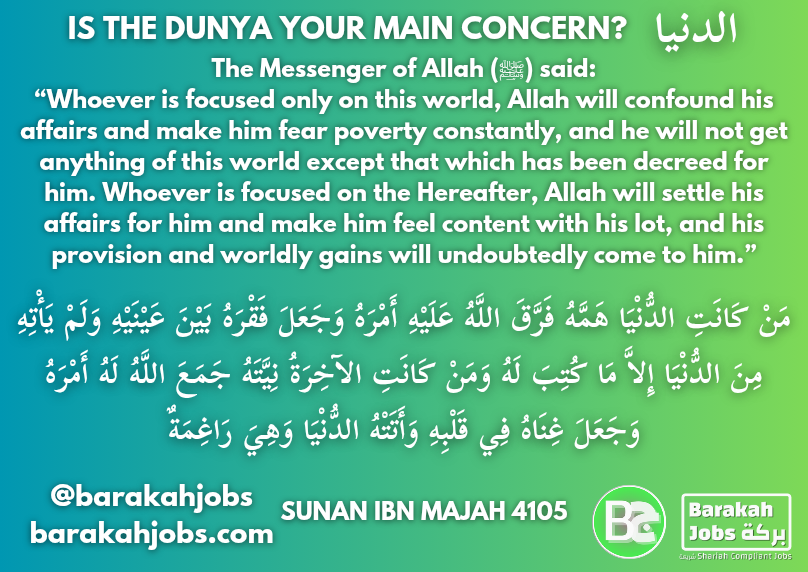
    Is the Dunya Your Main Concern? | Sunan Ibn Mājah 4105

    Seek the Akhira. The Dunya will follow.

    Imam Ibn Kathir رحمه الله said:
     
    "This dunya flees from the one who chases it, and chases the one who flees from it."
     
    [Tafsir Ibn Kathir 3/197]


    Sunan Ibn Majah 4105

    Abdur-Rahman bin Aban bin ‘Uthman bin ‘Affan narrated that his father said:
    “Zaid bin Thabit departed from Marwan at mid-day. I said: ‘He has not sent him out at this time of the day except for something he asked.’ So I asked him, and he said: ‘He asked me about some things we heard from the Messenger of Allah (ﷺ) say:

    “Whoever is focused only on this world, Allah will confound his affairs and make him fear poverty constantly, and he will not get anything of this world except that which has been decreed for him. Whoever is focused on the Hereafter, Allah will settle his affairs for him and make him feel content with his lot, and his provision and worldly gains will undoubtedly come to him.”

    رَسُولَ اللَّهِ ـ صلى الله عليه وسلم ـ يَقُولُ ‏ "‏ مَنْ كَانَتِ الدُّنْيَا هَمَّهُ فَرَّقَ اللَّهُ عَلَيْهِ أَمْرَهُ وَجَعَلَ فَقْرَهُ بَيْنَ عَيْنَيْهِ وَلَمْ يَأْتِهِ مِنَ الدُّنْيَا إِلاَّ مَا كُتِبَ لَهُ وَمَنْ كَانَتِ الآخِرَةُ نِيَّتَهُ جَمَعَ اللَّهُ لَهُ أَمْرَهُ وَجَعَلَ غِنَاهُ فِي قَلْبِهِ وَأَتَتْهُ الدُّنْيَا وَهِيَ رَاغِمَةٌ ‏"‏ ‏.

  • Dua of gratitude before sleeping Sahih Muslim 2715 blog_648.png

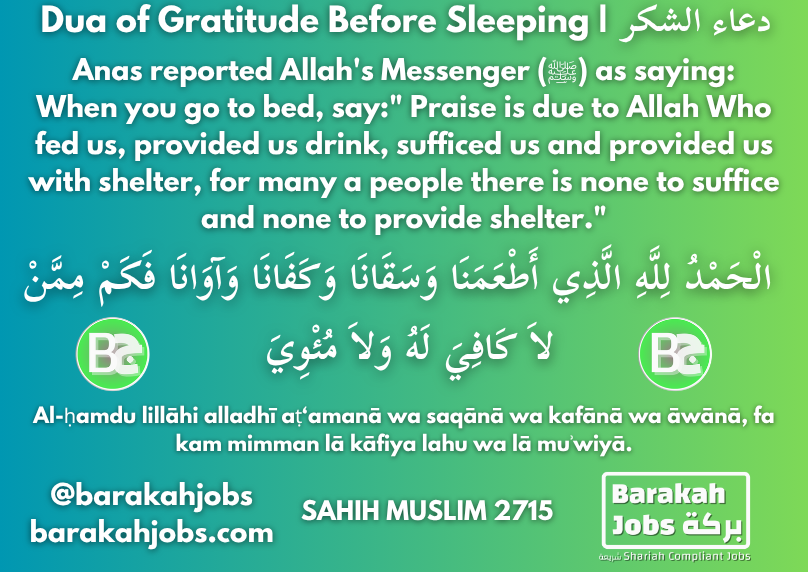
    Dua of Gratitude Before Sleeping | Sahih Muslim 2715

    دعاء الشكر قبل النوم

    Reference: Sahih Muslim 2715


    Anas reported Allah's Messenger (ﷺ) as saying:

    When you go to bed, say:" Praise is due to Allah Who fed us, provided us drink, sufficed us and provided us with shelter, for many a people there is none to suffice and none to provide shelter."

    Dua:

    الْحَمْدُ لِلَّهِ الَّذِي أَطْعَمَنَا وَسَقَانَا وَكَفَانَا وَآوَانَا فَكَمْ مِمَّنْ لاَ كَافِيَ لَهُ وَلاَ مُئْوِيَ

    Transliteration:

    Al-ḥamdu lillāhi alladhī aṭ‘amanā wa saqānā wa kafānā wa āwānā, fa kam mimman lā kāfiya lahu wa lā muʾwiyā.

    Reflection:

     
    Before sleeping, taking a moment to thank Allah reminds us of His countless blessings. Sleep is a gift, life is a blessing, and every breath is mercy. Saying this dua with sincerity helps you end the day in gratitude.

    Some of the righteous Salaf (predecessors) used to say:
    "If you want to know the blessings that Allāh has bestowed upon you, close your eyes." Look at how He He has blessed you with hearing, sight, reason, religious commitment, children, provision, a good life. 

    Remember, the blessings of Allah are abundant — your food, health, family, and faith are all signs of His mercy. Make it a habit to say Alhamdulillah.

    قُلْ: الْحَمْدُ لِلَّهِ

    Source:
    Sahih Muslim 2715, Book of Fasting, Chapter: Supplication When Going To Sleep


  • is liking good clothes arrogance Sahih Muslim 91 a Blog _270.png

    Is Liking Good Clothes Arrogance? | Sahih Muslim 91a

    Verily Allah is beautiful and he loves beauty.

    Reference: Sahih Muslim 91a
     
    Arabic:
    وَحَدَّثَنَا مُحَمَّدُ بْنُ الْمُثَنَّى، وَمُحَمَّدُ بْنُ بَشَّارٍ، وَإِبْرَاهِيمُ بْنُ دِينَارٍ، جَمِيعًا عَنْ يَحْيَى بْنِ حَمَّادٍ، - قَالَ ابْنُ الْمُثَنَّى حَدَّثَنِي يَحْيَى بْنُ حَمَّادٍ، - أَخْبَرَنَا شُعْبَةُ، عَنْ أَبَانَ بْنِ تَغْلِبَ، عَنْ فُضَيْلٍ الْفُقَيْمِيِّ، عَنْ إِبْرَاهِيمَ النَّخَعِيِّ، عَنْ عَلْقَمَةَ، عَنْ عَبْدِ اللَّهِ بْنِ مَسْعُودٍ، عَنِ النَّبِيِّ صلى الله عليه وسلم قَالَ ‏"‏ لاَ يَدْخُلُ الْجَنَّةَ مَنْ كَانَ فِي قَلْبِهِ مِثْقَالُ ذَرَّةٍ مِنْ كِبْرٍ ‏"‏ ‏.‏ قَالَ رَجُلٌ إِنَّ الرَّجُلَ يُحِبُّ أَنْ يَكُونَ ثَوْبُهُ حَسَنًا وَنَعْلُهُ حَسَنَةً ‏.‏ قَالَ ‏"‏ إِنَّ اللَّهَ جَمِيلٌ يُحِبُّ الْجَمَالَ الْكِبْرُ بَطَرُ الْحَقِّ وَغَمْطُ النَّاسِ ‏"‏ ‏.‏


    Translation (Sahih Muslim 91a):
    ʿAbdullāh ibn Masʿūd (may Allah be pleased with him) reported that the Prophet ﷺ said:
     
    “He who has in his heart the weight of a mustard seed of arrogance shall not enter Paradise.”


    A man said: “Indeed, a person loves that his clothes be fine and his shoes be fine.”
     
    The Prophet ﷺ replied:
     
    “Allah is Beautiful and loves beauty. Arrogance means rejecting the truth and looking down on people.”


    Source:
    Sahih Muslim, Book 1, Hadith 91a

  • How to organise your time for Barakah Blog_264.png

    How to Organise Your Time for Barakah? Insights from Sheikh Uthaymeen

    Time is a trust from Allah ﷻ, and how we use it determines the blessing we receive in our days. Many of us seek barakah in our time, yet struggle to find balance between worship, work, and rest. Sheikh Muhammad ibn al-Uthaymeen رحمه الله offered simple yet profound advice on how a believer can organise their time so that Allah places blessing within it.

     
    Here are his words:

    Organise your time so that Allah may bestow blessing upon it.
    Organise it, but do not make this arrangement rigid.
    Rather, let it be flexible according to the circumstances.
    Sometimes, what is less good may become better than what is good.
    But organise yourself and your work.
     
    The Prophet, peace and blessings of Allah be upon him, said:
    "The most beloved deeds to Allah are those that are consistent, even if they are small."
     
    For example, set aside an hour to read the Book of Allah.
    And an hour to read from the Hadiths of the Messenger, peace and blessings be upon him.
    An hour to reflect on the meanings of the Quran and the Hadiths.
    An hour to contemplate what you have done during your day and what you left undone.
     
    Organise yourself so that Allah may bless your days and your hours.

    Closing Remarks:

    Sheikh Ibn al-Uthaymeen’s رحمه الله reminder is timeless: when we organise our hours with sincerity and balance, Allah ﷻ places barakah in our time. True productivity is not about cramming more tasks into the day, but about filling our moments with purpose—connecting worship, work, and reflection. By following this guidance, we can transform our daily routines into a source of blessing, consistency, and peace, making every hour count in both our dunya and akhirah.


  • Quran and free resources blog_851.png

    New Resource Release: The Noble Qur’an (Arabic + English Translation, Hilali & Khan)

    Alhamdulillah, we are pleased to announce that a free PDF copy of The Noble Qur’an (Arabic + English Translation by Dr. Muhammad Taqi-ud-Din al-Hilali and Dr. Muhammad Muhsin Khan) is now available to all Barakah Jobs members through our Resources page.
     
    Click here to access the free Qur’an PDF
    https://barakahjobs.com/resource/noble-quran-arabic-english-hilali-khan
     
    This edition of the Qur’an is one of the most widely published translations worldwide, offering clear English meaning alongside the original Arabic text. We have added it to our platform to support our members not only in their professional growth but also in their spiritual journey.
     
    At Barakah Jobs, we are committed to making valuable resources accessible to our community. This Qur’an PDF is just the beginning — insha’Allah, more resources will be added soon, including:
     
    • Islamic texts and learning materials
    • Professional development tools
    • Study and training resources
    • Ebooks and guides
     
     
    We hope this benefits you and your family.
     
    Disclaimer:
    Barakah Jobs is providing this Qur’an translation as a free service for educational and personal use only. We do not sell, alter, or claim ownership of this work. The translation (The Noble Qur’an by Dr. Muhammad Taqi-ud-Din al-Hilali and Dr. Muhammad Muhsin Khan) is published by the King Fahd Complex for the Printing of the Holy Qur’an in Madinah, Saudi Arabia.
     
    We are not affiliated with the publishers, nor do we receive any financial benefit, referral, or commission from sharing this resource. Access to the resource requires free signup, but there is no cost involved.
     
    May Allah make the Qur’an a source of guidance, barakah, and light in our lives.